Your Org Has the Same Scaling Problem as a Badly Tuned Training Run
AI raised individual throughput but coordination overhead stayed fixed. For many product-engineering orgs, the bottleneck flipped from compute-bound to communication-bound.
I scale LLM training for a living, reducing communication overhead so GPUs spend more time computing. Coordination is becoming the binding constraint in organizations where AI has accelerated implementation but left management processes unchanged.
The bottleneck moved
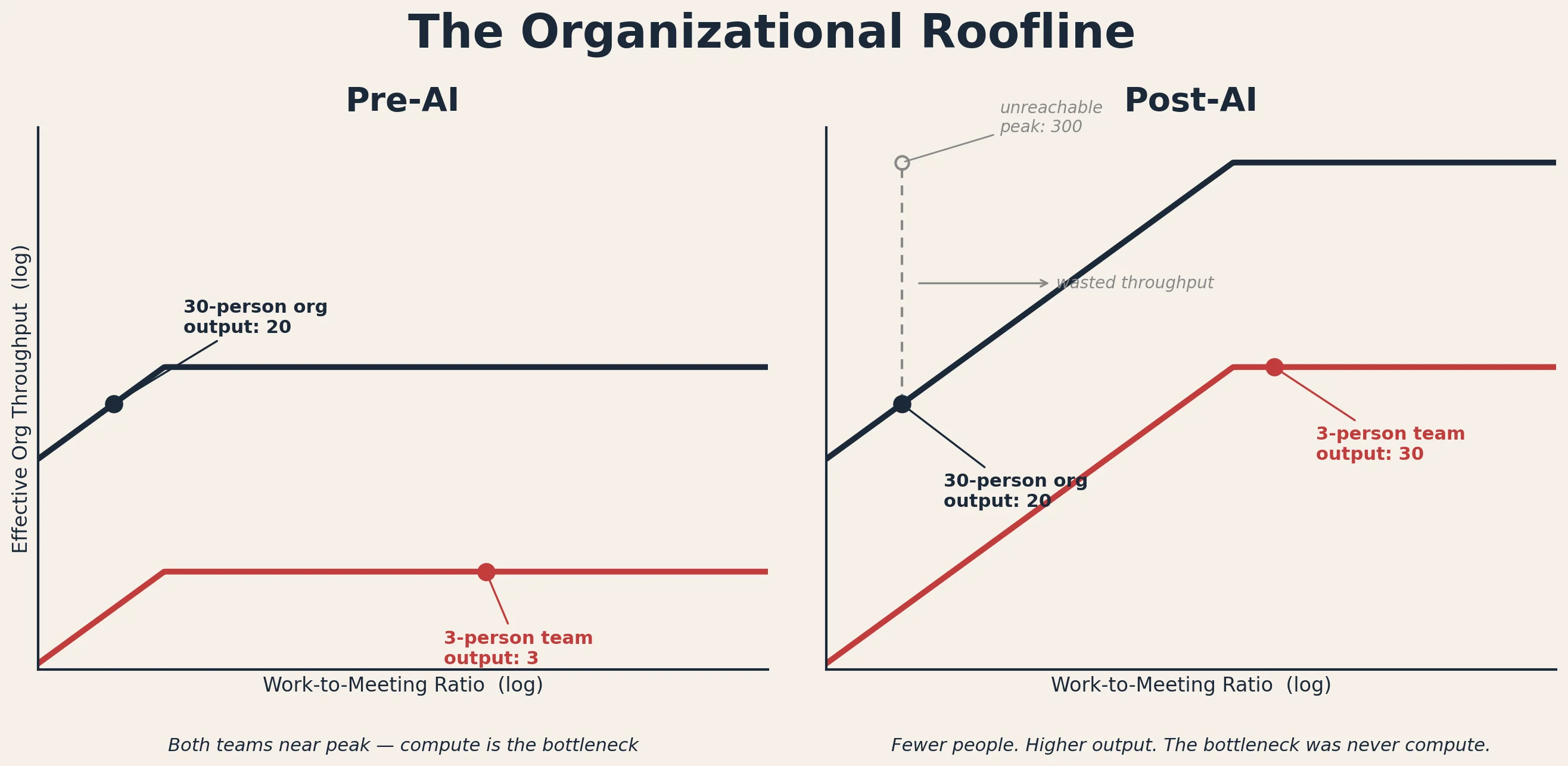
Every system hits one of two ceilings: the speed of individual work, or the overhead of coordination. This mirrors what performance engineers call the roofline model — your output is capped by whichever constraint binds first.
Pre-AI, orgs were compute-bound: individual output was the ceiling, so you hired more people and accepted the coordination cost. In one controlled study, developers completed a well-defined coding task 55% faster with AI. A separate randomized trial found that experienced developers working in mature codebases they knew well took 19% longer. The gain depends on the task, but AI can shift the binding constraint when it speeds up implementation.
Coordination did not speed up with implementation. Knowledge workers spend 57% of their time communicating and 43% creating, while meeting time has risen 252% since 2020, largely because of remote work.
A longitudinal study of 22,000 developers found that individual task completion rose 21% with AI tools while organizational delivery velocity stayed flat. PRs grew 154% larger and review time nearly doubled. DORA’s 2024 report reports the same industry-wide pattern: developers viewed AI positively, but delivery throughput was flat or declining and stability worsened.
Cross-team dependencies and shared-state services require some coordination. The avoidable cost comes from status meetings, roadmap alignments, and cross-team syncs created by the reporting structure rather than the work itself.
When Shopify deleted all recurring meetings of 3+ people as part of a broader restructuring, they recovered 322,000 hours in one month and completed 25% more projects. The company reduced headcount at the same time, so the meeting policy alone may not explain the improvement.
The organizational roofline: each team’s output is capped by whichever ceiling binds first — individual speed or coordination overhead.
What “taste” actually means
The scarce resource shifted from execution to judgment — what I have been calling taste: eliminating weak directions early and recognizing failure modes before implementation makes them expensive. The person who spots that a coding agent quietly dropped a retry policy because they know which failures are transient is exercising taste. The person whose instinct is to schedule a sync before investigating is substituting process for judgment.
Tech managers tend to spend more of their time in one of two modes. Some stay close to the work and cultivate judgment: they can inspect an architecture and anticipate failure modes before committing the team to a design. AI tools let them execute more of that judgment directly. They spread it across the team by hiring strong engineers and coaching them to make better decisions.
The other spent years relaying context between teams: aligning stakeholders, scheduling syncs, and tracking deadlines. AI automates status aggregation, timeline tracking, and cross-team updates. It does not automate the harder decisions: handling organizational politics, sequencing dependencies, and choosing among competing priorities. Those decisions used to be bundled with the relay work.
Most managers blend both modes. What matters is which one dominates their calendar: AI amplifies technical judgment and automates much of the mechanical relay work.
The fix is not “managers should learn to code with AI”
The fix is structural. I have watched this in distributed training itself: a three-person kernel team — one architect, two engineers — shipped a communication backend in four months that a twelve-person team at a peer lab spent a year matching. The difference was not talent. The larger team had weekly syncs, a program manager, and a planning process that consumed a third of their engineering hours. The smaller team had a shared channel and a whiteboard. Amazon’s 2025 shareholder letter describes a similar pattern at larger scale: six engineers, building on AI coding agents, shipped a new inference engine for Bedrock in 76 days — work estimated at 40 people for a year, though shareholder letters present self-selected successes. For product work with a well-defined surface, small teams with taste capture the speed-up while large teams absorb it into coordination.
Some coordination work is genuinely valuable: shielding the team from politics, mentoring through career-defining moments, and holding institutional memory. A player-coach can take on some of that work without becoming a dedicated relay between teams.
When a middle-management process requires each team to update every other team, the number of communication paths grows quadratically with the number of participants. Distributed systems call the corresponding topology all-to-all. Organizations should remove relay work that exists only to serve the hierarchy. The transition has a human cost: people with real coordination expertise cannot change roles overnight. Executives still need to aggregate information, allocate resources, and set direction. Those responsibilities remain necessary after relay work is removed.
If your team does product work with a well-defined surface and your AI adoption push has not moved the needle, measure your work-to-meeting ratio.